E-Commerce Website Development
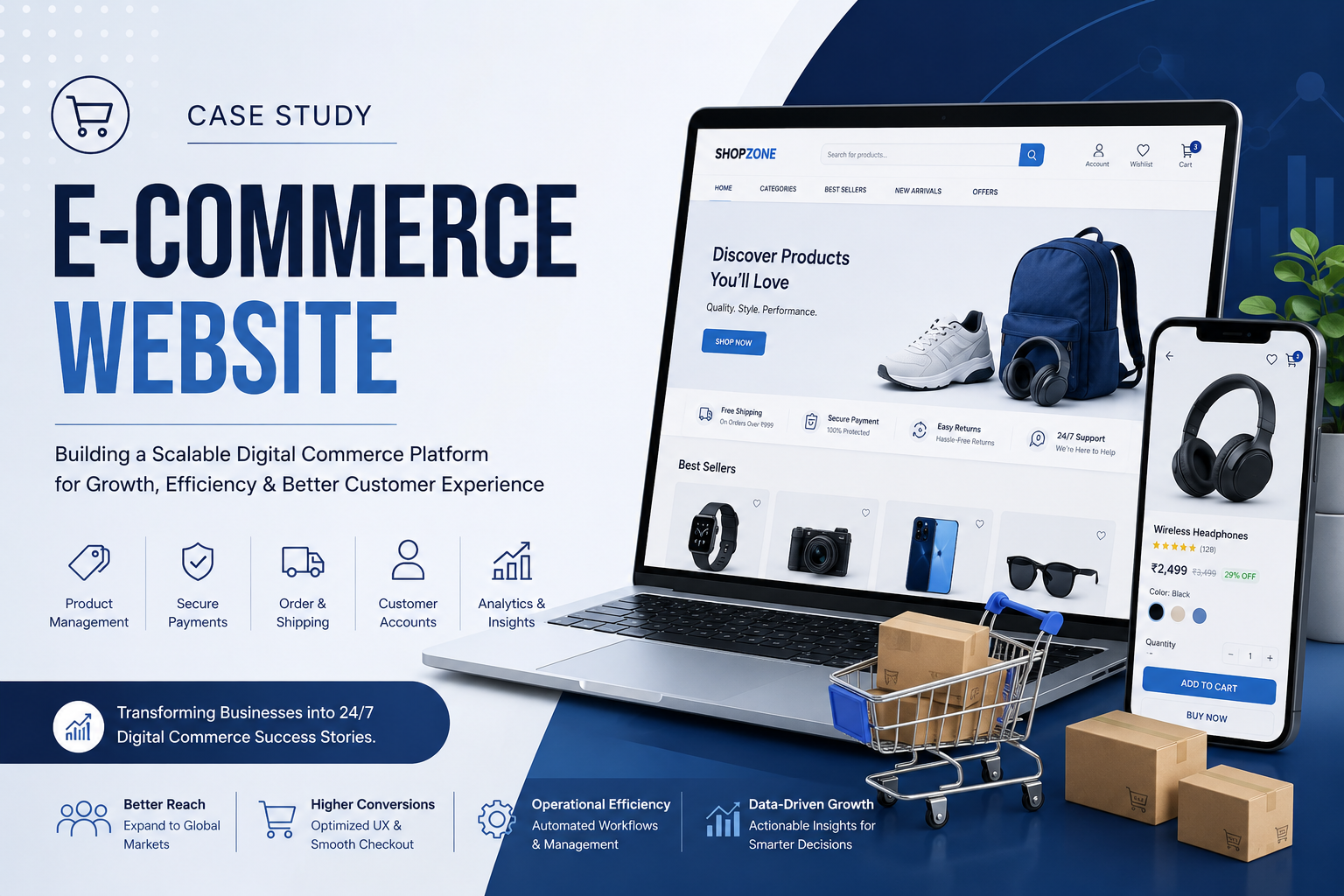
This case study explores the development of a modern e-commerce website designed to help businesses establish a strong digital sales presence. The platform enables customers to discover products, search and filter catalogs, view detailed product information, add items to their cart, complete secure payments, and track orders from a single, user-friendly interface. The e-commerce solution integrates essential business functions including product and inventory management, secure payment processing, order management, customer accounts, shipping, discounts, reviews, analytics, and marketing. A mobile-first and performance-focused approach ensures a smooth experience across devices, while SEO-friendly architecture helps improve online visibility and organic reach. Security, scalability, and quality assurance are treated as core components of the platform. Features such as secure authentication, server-side validation, protected payment workflows, responsive design, performance optimization, and comprehensive testing help create a reliable and trustworthy shopping environment. Overall, a professionally developed e-commerce website can transform a traditional business into a 24/7 digital commerce platform, expanding market reach, reducing manual operations, improving customer experience, increasing sales opportunities, and providing valuable data for long-term business growth.
Introduction
The rapid growth of digital commerce has fundamentally changed the way businesses sell products and how customers discover, evaluate, purchase, and receive them. An e-commerce website is no longer simply an online product catalog with a payment button. It has become a complete digital commerce ecosystem that combines product discovery, customer experience, payments, inventory, logistics, marketing, analytics, security, and customer retention.
Modern e-commerce users expect websites to be fast, mobile-friendly, easy to navigate, trustworthy, and capable of completing purchases with minimal friction. Current e-commerce UX research emphasizes the importance of mobile-first experiences, simplified checkout, transparent pricing, strong product information, and reliable performance.
This case study explores how a professionally engineered e-commerce website can transform a traditional business into a scalable digital sales platform.
1. Project Overview
Project Type
E-Commerce Website Development
Business Objective
The primary objective was to build a modern e-commerce platform that enables a business to:
Sell products online 24/7
Reach customers beyond physical locations
Provide a smooth shopping experience
Accept multiple payment methods
Manage products and inventory efficiently
Process and track customer orders
Build customer loyalty
Support digital marketing and SEO
Collect actionable business analytics
Scale as product catalogs and customer traffic increase
The website needed to function not merely as a storefront, but as an integrated business platform connecting customers, products, payments, inventory, order processing, marketing, and administration.
2. The Business Challenge
Before implementing a dedicated e-commerce platform, many businesses face challenges associated with traditional sales channels.
Customers may need to:
Visit a physical store.
Contact the business manually.
Ask about product availability.
Compare products with limited information.
Complete purchases through manual processes.
Contact the business again for order updates.
This creates operational friction for both customers and business teams.
A digital commerce platform addresses these problems by allowing customers to discover products, evaluate them, place orders, make payments, and track deliveries through a single system.
Major challenges identified
Limited Market Reach
A physical store primarily serves customers within a geographical area. An e-commerce website allows businesses to present their products to customers across cities, regions, and potentially international markets.
Limited Operating Hours
A physical store has opening and closing times. An e-commerce website can accept orders continuously, allowing customers to shop whenever convenient.
Manual Order Processing
Manual order handling can result in:
Incorrect order information
Delayed responses
Inventory inconsistencies
Communication overhead
Difficult order tracking
Poor Product Discovery
Customers need efficient ways to find products through:
Search
Categories
Filters
Sorting
Recommendations
Related products
Checkout Friction
The checkout stage is one of the most critical parts of an e-commerce experience. Baymard-based research cited by Shopify reports an average cart abandonment rate of around 70%, with unnecessary costs, forced account creation, and complicated checkout being important abandonment factors.
3. Project Goals
The project was structured around six major goals.
Goal 1: Build a Professional Digital Storefront
Create a visually engaging interface that communicates the brand's identity while making product discovery straightforward.
Goal 2: Improve Customer Experience
Reduce unnecessary steps between product discovery and purchase.
Goal 3: Increase Conversion Opportunities
Optimize product pages, cart functionality, checkout, promotions, and calls-to-action.
Goal 4: Automate Business Operations
Reduce manual work associated with:
Orders
Inventory
Customer accounts
Payments
Notifications
Product management
Goal 5: Create a Scalable Architecture
The platform should support increasing:
Products
Customers
Orders
Traffic
Transactions
Marketing campaigns
Goal 6: Establish a Long-Term Digital Growth Platform
The website should provide a foundation for SEO, analytics, remarketing, personalization, loyalty programs, and future integrations.
4. Target Users
The e-commerce platform was designed around several user groups.
New Customers
New visitors need to quickly understand:
What the company sells
Why they should trust the business
Which products are available
How much products cost
How delivery works
How payments are protected
What happens if they want to return an item
Returning Customers
Returning customers expect faster purchasing through:
Saved addresses
Previous orders
Wishlist
Personalized recommendations
Faster checkout
Reordering
Mobile Customers
Mobile users require:
Responsive layouts
Large touch targets
Simple navigation
Fast-loading pages
Mobile-friendly checkout
Easy payment options
Mobile commerce is particularly important because mobile devices represent a major share of modern e-commerce activity.
Administrators
Business administrators require an internal system for:
Product management
Category management
Inventory
Orders
Customers
Discounts
Shipping
Reports
Content management
5. Solution Architecture
The proposed e-commerce platform consists of several interconnected layers.
Frontend Layer
Responsible for:
Homepage
Product listing
Product details
Search
Filters
Cart
Checkout
Customer account
Order tracking
Promotional pages
Application Layer
Responsible for business logic such as:
Product management
Pricing
Discounts
Cart calculations
Order creation
Inventory updates
Customer management
Payment processing
Notifications
Database Layer
Stores:
Products
Categories
Variants
Customers
Addresses
Orders
Order items
Payments
Inventory
Reviews
Coupons
Wishlists
Integration Layer
Connects the platform with external services such as:
Payment gateways
Shipping providers
Email services
SMS services
Analytics platforms
CRM systems
Marketing platforms
Administration Layer
Provides authorized business users with control over the entire commerce operation.
6. Homepage Experience
The homepage serves as the primary entry point for customers.
A strong e-commerce homepage should immediately communicate:
Brand identity
Main product categories
Featured products
Current offers
Best sellers
New arrivals
Customer trust signals
Shipping benefits
Calls-to-action
Recommended Homepage Structure
Header
Logo
Search
Categories
Account
Wishlist
Cart
Hero Section
A strong promotional message with a clear CTA.
Example:
Discover Products You'll Love
Product Categories
Visual category cards help customers move directly into relevant product collections.
Featured Products
Showcase high-priority products.
Best Sellers
Highlight products with proven customer demand.
Promotional Banner
Display limited-time offers or seasonal campaigns.
Customer Reviews
Social proof can help reduce purchase hesitation.
Trust Section
Examples:
Secure payments
Easy returns
Fast shipping
Customer support
7. Product Catalog
The product catalog is the core of an e-commerce platform.
Products should be organized into logical categories and subcategories.
For example:
Electronics
Smartphones
Laptops
Accessories
Fashion
Men
Women
Shoes
Accessories
Home & Lifestyle
Furniture
Kitchen
Decor
A structured taxonomy improves both usability and SEO.
8. Advanced Product Search
An effective search system allows customers to find products without manually browsing through every category.
Important capabilities include:
Keyword search
Autocomplete
Search suggestions
Product thumbnails
Category suggestions
Brand filtering
Price filtering
Rating filtering
Availability filtering
Sorting
A modern e-commerce platform should also consider typo tolerance and relevant search ranking.
For example, if a customer searches:
"iphon 15"
the system should ideally understand that the customer is looking for:
"iPhone 15"
9. Product Filtering and Sorting
Filtering becomes increasingly important as the catalog grows.
Customers may filter products by:
Price
Brand
Category
Size
Color
Rating
Availability
Material
Features
Sorting options may include:
Recommended
Popular
Newest
Price: Low to High
Price: High to Low
Highest Rated
These tools reduce the amount of effort customers need to find the right product. Modern e-commerce feature guidance consistently identifies search, filtering, product information, and navigation as core capabilities.
10. Product Detail Page
The product detail page is one of the most important conversion pages on the website.
A professional product page should include:
Product Images
High-resolution images
Multiple angles
Zoom functionality
Product gallery
Optional video
Product Information
Product name
Price
Discount
Product description
Specifications
Available variants
Stock status
Purchase Controls
Quantity selector
Add to Cart
Buy Now
Wishlist
Customer Confidence
Ratings
Reviews
Shipping information
Return policy
Warranty information
Secure payment indicators
Additional Discovery
Related products
Frequently bought together
Recently viewed products
The product page effectively becomes the salesperson of the digital store.
11. Shopping Cart
The shopping cart should provide a clear summary of the customer's intended purchase.
It should display:
Product image
Product name
Variant
Quantity
Unit price
Discount
Subtotal
Shipping
Taxes
Final total
Customers should be able to:
Increase quantity
Decrease quantity
Remove products
Save products for later
Apply coupons
Continue shopping
Proceed to checkout
Unexpected costs are a major source of checkout abandonment, so pricing and shipping information should be communicated as early and clearly as possible.
12. Checkout System
Checkout is the point where browsing becomes revenue.
The checkout process should therefore be intentionally simple.
Recommended Flow
Step 1 — Customer Information
Name
Email
Phone
Step 2 — Shipping Address
Address
City
State
PIN/ZIP code
Country
Step 3 — Delivery Method
Standard delivery
Express delivery
Other available options
Step 4 — Payment
Card
UPI
Net banking
Wallets
Other supported methods
Cash on Delivery where applicable
Step 5 — Order Review
Display:
Products
Quantity
Shipping
Taxes
Discount
Final payable amount
Step 6 — Order Confirmation
Show:
Order number
Payment status
Estimated delivery
Order summary
Tracking option
Guest checkout and fewer unnecessary form fields can reduce friction, while mobile-first checkout design is especially important.
13. Payment Integration
A reliable payment infrastructure is essential for e-commerce.
For an India-focused store, payment support can include:
UPI
Credit cards
Debit cards
Net banking
Digital wallets
Cash on Delivery
Other supported payment methods
The architecture should ensure that payment status is verified server-side rather than trusting client-side responses.
A secure implementation should also protect:
Payment credentials
Customer information
Transaction data
API keys
Webhook endpoints
14. Order Management
Once an order is placed, it enters the order management system.
A typical order lifecycle is:
Order Placed → Payment Confirmed → Processing → Packed → Shipped → Out for Delivery → Delivered
The customer should be able to see the current status.
Administrators should be able to:
View orders
Search orders
Filter orders
Update order status
Verify payments
Process refunds
Manage cancellations
Add tracking information
This creates transparency for both the business and the customer.
15. Inventory Management
Inventory synchronization is critical.
The system should track:
Available quantity
Reserved quantity
Sold quantity
Low-stock products
Out-of-stock products
Product variants
For example, if a product has only five units remaining and a customer purchases two, the system should automatically update the available inventory.
Inventory should ideally be updated through trusted backend transactions to avoid race conditions and overselling.
16. Customer Account System
Customers should have access to a personal dashboard containing:
Profile
Name
Email
Phone
Addresses
Home
Office
Other saved addresses
Orders
Current orders
Previous orders
Order details
Wishlist
Customers can save products for future purchases.
Reviews
Customers can review eligible purchased products.
Account Security
The system should support secure authentication and appropriate session management.
17. Wishlist and Personalization
Wishlist functionality allows customers to save products without immediately purchasing them.
Personalization can further improve discovery by showing:
Recently viewed products
Related products
Recommended products
Frequently purchased products
Personalized offers
However, personalization should be implemented responsibly, with appropriate privacy controls and transparent data practices.
18. Discount and Coupon System
A flexible promotion engine can support:
Percentage discounts
Fixed discounts
Category discounts
Product-specific discounts
Minimum-order discounts
First-order offers
Seasonal campaigns
Coupon codes
Limited-time offers
For example:
WELCOME10
Get 10% off your first order.
The backend should validate every discount rather than relying on frontend calculations.
19. Shipping and Delivery
The shipping system should provide customers with clear delivery information.
Features can include:
Shipping calculation
Delivery estimates
PIN/ZIP code serviceability
Multiple shipping methods
Tracking
Shipping notifications
Delivery status
For Indian e-commerce, PIN-code serviceability can be particularly useful because customers want to know whether delivery is available to their location before completing an order.
20. Notifications
Automated communication should be integrated into the order lifecycle.
Customers may receive notifications for:
Account creation
Order confirmation
Payment confirmation
Order processing
Shipment
Delivery
Cancellation
Refund
Promotional campaigns
Channels can include:
Email
SMS
Push notifications
Messaging integrations where appropriate
21. Reviews and Ratings
Reviews provide social proof.
The platform should allow verified customers to submit:
Star ratings
Written reviews
Product feedback
Optional images
Administrators should have moderation capabilities to detect spam, abuse, or inappropriate content.
Reviews can also provide valuable product insights to the business.
22. Mobile-First Design
Modern e-commerce development should begin with mobile usability rather than treating mobile as a secondary version.
Important considerations include:
Responsive layouts
Touch-friendly controls
Sticky navigation where appropriate
Mobile-friendly filters
Optimized product images
Simplified forms
Fast checkout
Large CTA buttons
Mobile performance matters particularly during checkout because small screens make lengthy forms and repeated data entry more difficult.
23. Performance Optimization
Performance has a direct relationship with user experience.
Optimization strategies include:
Image Optimization
WebP/AVIF where appropriate
Responsive images
Lazy loading
Proper dimensions
Compression
Frontend Optimization
Code splitting
Component optimization
Minification
Efficient rendering
Reduced JavaScript
Backend Optimization
Database indexing
Query optimization
Caching
API optimization
Infrastructure
CDN
Edge caching
Scalable hosting
Monitoring
Core Web Vitals should be continuously monitored, particularly metrics such as Largest Contentful Paint, Interaction to Next Paint, and Cumulative Layout Shift.
24. Search Engine Optimization
An e-commerce website needs a strong SEO foundation.
Important elements include:
SEO-friendly URLs
Product metadata
Category metadata
Canonical URLs
XML sitemap
Robots.txt
Structured data
Product schema
Breadcrumb schema
Organization schema
Optimized headings
Descriptive image alt text
Internal linking
Each important product should ideally have a unique, indexable URL.
SEO should also be supported by useful content such as buying guides, product comparisons, FAQs, and educational articles.
25. Security Architecture
Security is fundamental because an e-commerce platform handles sensitive customer and transaction information.
Key Security Controls
HTTPS
All production traffic should use HTTPS.
Secure Authentication
Passwords should never be stored in plain text.
Authorization
Administrative functions should be protected through role-based access control.
Input Validation
All user input should be validated and sanitized.
Server-Side Validation
Critical business rules must be validated on the server.
Secure API Design
Sensitive endpoints should require proper authentication and authorization.
Rate Limiting
Rate limiting can help protect authentication, search, checkout, and API endpoints from abuse.
Secure Cookies
Authentication cookies should use appropriate security attributes such as:
Secure
HttpOnly
SameSite
Payment Security
Payment credentials and secrets should never be exposed through frontend JavaScript or public environment variables.
26. Admin Dashboard
The administration dashboard provides centralized control.
Dashboard Metrics
Administrators can monitor:
Revenue
Orders
Customers
Average order value
Conversion rate
Best-selling products
Low-stock products
Product Management
Admins can:
Add products
Edit products
Delete/archive products
Upload images
Manage variants
Set prices
Manage stock
Order Management
Admins can:
View orders
Change status
Process refunds
Manage cancellations
Add tracking information
Customer Management
Admins can view appropriate customer information and order history while following applicable privacy requirements.
27. Analytics and Business Intelligence
Analytics allows the business to understand how customers interact with the website.
Important metrics include:
Acquisition
Traffic
Search traffic
Social traffic
Paid traffic
Referral traffic
Engagement
Product views
Search usage
Category views
Time on site
Commerce
Add-to-cart rate
Checkout initiation
Conversion rate
Average order value
Revenue per visitor
Retention
Repeat purchase rate
Customer lifetime value
Returning customer percentage
Analytics should be used to identify where users drop out of the purchase funnel.
28. Marketing Integration
An e-commerce website should work together with the company's broader marketing ecosystem.
Possible integrations include:
Email marketing
Social media
Search advertising
Retargeting
CRM
Customer segmentation
Promotional campaigns
Abandoned-cart recovery
For example, a customer who adds a product to their cart but does not complete checkout may enter an appropriate recovery campaign.
29. Scalability
The architecture should be designed for growth.
A small store may initially have:
Hundreds of products
Hundreds of customers
Limited daily orders
Over time it may grow to:
Thousands of products
Millions of visitors
Large transaction volumes
Multiple warehouses
Multiple regions
The platform should therefore separate major concerns and avoid creating a tightly coupled system that becomes difficult to maintain.
Potential scalability strategies include:
Caching
Database indexing
CDN distribution
Horizontal scaling
Background jobs
Queue-based processing
Search infrastructure
Read replicas
Object storage
30. Quality Assurance Strategy
A professional e-commerce website requires comprehensive testing.
Functional Testing
Test:
Registration
Login
Product search
Filters
Cart
Checkout
Coupons
Payments
Orders
Refunds
Account management
UI Testing
Verify:
Responsive design
Browser compatibility
Navigation
Forms
Buttons
Product images
Error messages
Performance Testing
Test:
Page load
API response time
Database performance
Concurrent users
Checkout performance
Security Testing
Test:
Authentication
Authorization
Input validation
Session handling
API security
Rate limiting
Sensitive data exposure
Payment Testing
Test:
Successful payments
Failed payments
Cancelled transactions
Duplicate callbacks
Payment timeout
Refunds
Webhook verification
End-to-End Testing
The most important user journey should be tested from beginning to end:
Landing Page → Product → Cart → Checkout → Payment → Order Confirmation → Tracking
31. Key User Journey
A typical customer journey can be represented as:
Discover
↓
Browse
↓
Search / Filter
↓
Evaluate Product
↓
Add to Cart
↓
Checkout
↓
Payment
↓
Order Confirmation
↓
Shipping
↓
Delivery
↓
Review
↓
Repeat Purchase
Every stage represents an opportunity to improve customer satisfaction and business revenue.
32. Business Impact
A well-engineered e-commerce website can produce significant business benefits.
Increased Market Reach
Products become accessible to customers beyond physical store locations.
24/7 Sales
Customers can purchase products at any time.
Reduced Manual Operations
Automation reduces repetitive administrative work.
Better Customer Experience
Customers receive immediate access to product information, ordering, payments, and tracking.
Improved Marketing Capability
The business can measure campaigns and customer behavior.
Better Decision Making
Analytics provide insights into:
Product demand
Customer behavior
Revenue
Marketing performance
Inventory requirements
Increased Customer Retention
Features such as accounts, Wishlist, personalized recommendations, loyalty programs, and post-purchase communication can encourage repeat purchases.
33. Key Performance Indicators
The success of the e-commerce platform should be measured using clear KPIs.
KPI | Purpose |
|---|---|
Conversion Rate | Measures visitors who become customers |
Add-to-Cart Rate | Measures product purchase intent |
Cart Abandonment Rate | Identifies checkout friction |
Average Order Value | Measures revenue per order |
Customer Acquisition Cost | Measures marketing efficiency |
Customer Lifetime Value | Measures long-term customer value |
Repeat Purchase Rate | Measures retention |
Checkout Completion Rate | Measures checkout effectiveness |
Page Load Performance | Measures technical experience |
Revenue per Visitor | Measures overall commercial efficiency |
34. Challenges During Development
Several technical and business challenges can arise during e-commerce development.
Challenge 1: Balancing Design and Performance
High-quality visuals can negatively affect performance if images and animations are not optimized.
Solution: Use responsive images, compression, lazy loading, and controlled animation.
Challenge 2: Preventing Inventory Conflicts
Multiple users may attempt to purchase the same limited-stock product.
Solution: Implement transactional inventory updates and reliable stock reservation strategies.
Challenge 3: Payment Reliability
Payment providers can return delayed, failed, or duplicate responses.
Solution: Use verified server-side webhooks and idempotent order processing.
Challenge 4: Checkout Abandonment
Long forms and unexpected costs can discourage customers.
Solution: Reduce unnecessary fields, provide transparent pricing, enable guest checkout, and support convenient payment methods.
Challenge 5: Scalability
Traffic can increase dramatically during promotions and seasonal campaigns.
Solution: Use caching, CDN infrastructure, scalable application architecture, optimized database queries, and monitoring.
35. Future Enhancements
Once the core e-commerce platform is stable, additional capabilities can be introduced.
AI-Powered Product Recommendations
Machine-learning models can recommend products based on customer behavior.
AI Search
Customers could search using natural language such as:
"Show me black running shoes under ₹5,000."
Voice Search
Voice-based product discovery can make mobile shopping more accessible.
Progressive Web App
A PWA can provide an app-like shopping experience without requiring customers to install a traditional application.
Loyalty Program
Customers can earn:
Points
Rewards
Discounts
Membership benefits
Advanced Personalization
The platform can personalize:
Homepage products
Recommendations
Offers
Search results
Marketing campaigns
Omnichannel Commerce
The business can eventually connect:
Website
Mobile application
Physical stores
Social commerce
Customer support
36. Final Outcome
The completed e-commerce platform becomes much more than an online store.
It acts as a centralized digital commerce infrastructure connecting:
Customers + Products + Inventory + Payments + Orders + Shipping + Marketing + Analytics
The combination of responsive UX, optimized product discovery, simplified checkout, secure payment processing, automated order management, analytics, SEO, and scalable architecture creates a strong foundation for long-term digital commerce growth.
Modern e-commerce best practices increasingly emphasize that successful stores must combine product catalog functionality, mobile responsiveness, search, filtering, secure checkout, inventory management, analytics, SEO, and scalable infrastructure rather than treating these as isolated features.
Conclusion
An e-commerce website is one of the most powerful digital assets a modern business can build. When properly engineered, it can transform a traditional sales operation into an always-available, measurable, automated, and scalable digital business.
The most successful approach is not simply to build a website containing products and a payment gateway. The platform must be designed around the complete customer journey—from discovery to purchase and from delivery to repeat purchase.
For businesses planning an e-commerce platform, the priorities should therefore be:
Customer-first UX
Mobile-first design
Fast performance
Simple checkout
Secure payments
Reliable inventory and order management
Strong SEO
Actionable analytics
Scalable architecture
Continuous optimization
Ultimately, the e-commerce website should become a growth engine for the business—not simply a digital catalog.