Static and Dynamic Websites
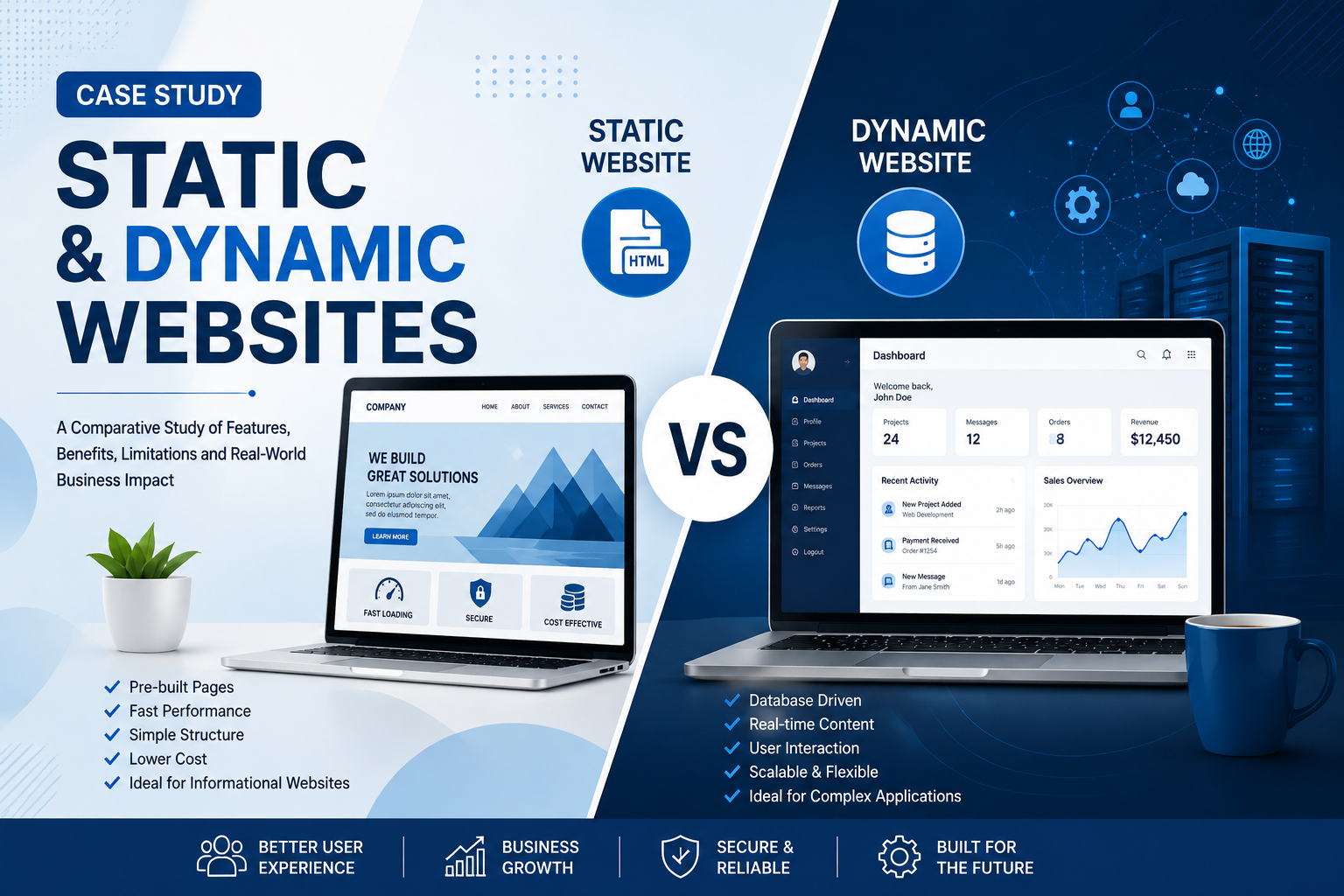
Static and dynamic websites are two important approaches to modern web development, each serving different business requirements. A static website consists mainly of pre-built webpages and is best suited for businesses that need a simple online presence, such as company profiles, portfolios, landing pages, and service websites. Static websites are generally fast, secure in terms of having a smaller application surface, easy to host, and relatively inexpensive to develop and maintain. A dynamic website generates or retrieves content based on databases, user interactions, application logic, or external services. It is suitable for businesses requiring features such as customer accounts, e-commerce, online bookings, dashboards, job portals, content management systems, and personalized experiences. The case study of ABC Solutions shows how a business can start with a simple static website and later adopt dynamic functionality as its requirements grow. This demonstrates that website architecture should be selected according to business needs, budget, functionality, security, and future growth. Overall, static websites are ideal for simplicity and performance, while dynamic websites are better suited for interactive and data-driven business applications. In many modern projects, a hybrid approach combining both can provide the best balance between performance, flexibility, and functionality.
Introduction
A website is one of the most important digital assets for a modern business. It provides an online identity, communicates information to customers, promotes products and services, generates leads, and supports business operations. Depending on the purpose, functionality, content requirements, and level of user interaction, websites can generally be classified into two major categories: Static Websites and Dynamic Websites.
Although both types of websites are used to provide information and interact with visitors, they differ significantly in their architecture, content management, development process, performance, scalability, and maintenance requirements.
This case study examines static and dynamic websites through the example of a hypothetical business, ABC Solutions, and evaluates how each approach can be used to meet different business requirements.
1. Business Background
ABC Solutions is a growing IT and digital services company that provides:
Website development
Software development
Digital marketing
Cloud solutions
IT consulting
Business automation
Technical support
When ABC Solutions started its business, it required a simple online presence to introduce the company, display its services, provide contact information, and establish credibility.
At the beginning, the company did not require complex features such as customer accounts, online dashboards, automated bookings, or database-driven content.
As the company grew, its requirements changed. It needed to manage hundreds of service pages, publish articles, manage customer enquiries, display projects, provide personalized content, and integrate its website with other business systems.
This situation provides a useful example of the difference between a static and a dynamic website.
2. What Is a Static Website?
A static website is a website in which the content of each webpage is generally stored as pre-built HTML, CSS, and JavaScript files. When a visitor requests a page, the server delivers the prepared files to the visitor's browser.
The content usually remains the same for every visitor unless a developer manually changes the underlying files.
For example, a small business website might contain:
Home
About Us
Services
Portfolio
Contact
Company Profile
If the company wants to change the text on the Services page, a developer may need to edit the relevant HTML file and deploy the updated version.
Example
Suppose ABC Solutions has a page displaying:
"We provide professional website development services for small and medium-sized businesses."
This information remains the same for all visitors.
If ABC Solutions wants to change this statement, the website files need to be modified and redeployed.
3. Characteristics of Static Websites
Static websites generally have the following characteristics:
3.1 Pre-Built Content
Pages are created in advance and delivered to visitors largely as they are stored.
3.2 Simple Architecture
A basic static website may require only HTML, CSS, JavaScript, and a web server or hosting platform.
3.3 Fast Performance
Because pages can be served directly without complex database queries or server-side processing, static websites can be extremely fast.
3.4 Easy Hosting
Static websites can often be hosted using relatively simple and inexpensive hosting solutions.
3.5 Limited User Interaction
Traditional static websites generally provide less personalized interaction than database-driven applications.
3.6 Manual Content Updates
Changing content may require editing source files and publishing a new version.
4. Advantages of Static Websites
4.1 High Performance
Static websites can load very quickly because the server can deliver pre-built files without performing complex processing for every request.
Fast performance improves user experience and can contribute to better search visibility when other SEO factors are also properly implemented.
4.2 Lower Hosting Requirements
A simple static website does not necessarily require a database server or complex backend infrastructure.
This can reduce hosting and infrastructure costs.
4.3 Better Security Surface
Because a basic static website may have no database, login system, or server-side application logic, there are fewer backend components that need to be protected.
However, this does not mean that static websites are completely secure. Websites still need HTTPS, secure deployment practices, updated dependencies, and appropriate access controls.
4.4 Easy Deployment
Static files can be deployed relatively easily using modern hosting and deployment platforms.
4.5 Reliability
With fewer server-side dependencies, static websites can be highly reliable and capable of handling large amounts of traffic when appropriately hosted.
5. Limitations of Static Websites
Despite their advantages, static websites have several limitations.
5.1 Manual Updates
If a company has hundreds of pages, manually updating content can become inefficient.
5.2 Limited Personalization
A traditional static website generally displays the same content to visitors rather than dynamically adapting to each user.
5.3 Limited Database Integration
Complex applications involving customer records, orders, accounts, bookings, and dashboards generally require backend functionality and data storage.
5.4 Limited Business Automation
A simple static website cannot by itself provide sophisticated workflows such as automated order processing or customer account management.
5.5 Scalability of Content Management
Although static-site generators and modern content management workflows can address some of these limitations, a purely manually maintained static website can become difficult to manage as content grows.
6. What Is a Dynamic Website?
A dynamic website generates or retrieves content based on user requests, database information, application logic, user accounts, external services, or other changing data.
Instead of simply delivering a pre-written page, the server or application can process information and generate an appropriate response.
A dynamic website may use technologies such as:
PHP
Node.js
Python
Java
.NET
Databases such as MySQL, PostgreSQL, MongoDB, or others
APIs
Content management systems
Server-side or client-side application frameworks
Example
Suppose a customer logs into the ABC Solutions customer portal.
The website can retrieve that customer's information from a database and display:
Their name
Active projects
Support tickets
Invoices
Notifications
Project status
Personalized recommendations
The content is not necessarily identical for every visitor. It can be generated based on the user's identity and the current data available to the application.
7. Characteristics of Dynamic Websites
7.1 Database Integration
Dynamic websites commonly retrieve and store information using databases.
7.2 User Interaction
They can support complex interactions such as registration, login, shopping carts, bookings, comments, dashboards, and online payments.
7.3 Real-Time or Frequently Changing Information
Dynamic websites can display information that changes frequently, such as inventory, account information, prices, news, appointments, and order status.
7.4 Personalization
Different users can receive different information based on their accounts, preferences, permissions, location, activity, or other business rules.
7.5 Content Management
Dynamic websites can allow authorized staff to add, edit, or remove content through an administrative interface without directly modifying every webpage's source code.
8. Advantages of Dynamic Websites
8.1 Easy Content Management
A content management system can allow non-technical employees to update articles, services, images, products, and other content.
For ABC Solutions, the marketing team could publish a new blog article without asking a developer to manually edit the website files.
8.2 Personalization
Dynamic websites can customize the experience based on users and their interactions.
For example, an e-commerce website can display recommendations based on a customer's browsing or purchasing history.
8.3 Database-Driven Applications
Dynamic websites are suitable for applications that need to store and process information.
Examples include:
E-commerce stores
Banking portals
Learning management systems
Customer portals
Job portals
Booking systems
Social networks
Inventory systems
8.4 Business Automation
A dynamic website can connect with business systems and automate repetitive processes.
For example:
Customer Enquiry → Database → Sales Notification → Follow-Up → CRM
This can reduce manual work and improve operational efficiency.
8.5 Scalability of Functionality
Dynamic systems can support increasingly sophisticated features as the business grows.
9. Limitations of Dynamic Websites
9.1 Higher Development Cost
Dynamic websites generally require more development effort because they may involve frontend interfaces, backend logic, databases, APIs, authentication, and security controls.
9.2 Greater Maintenance Requirements
More components mean more areas that need maintenance, monitoring, testing, and updates.
9.3 Security Risks
Dynamic applications can introduce additional security risks involving authentication, databases, APIs, user input, sessions, access control, and server-side logic.
Strong security practices are therefore essential.
9.4 Infrastructure Requirements
Some dynamic applications require databases, application servers, background services, storage systems, and other infrastructure.
9.5 Potential Performance Complexity
Dynamic requests can require database queries and application processing. Without proper architecture, caching, optimization, and infrastructure, this can affect performance.
10. Static vs Dynamic Website: Comparison
Feature | Static Website | Dynamic Website |
|---|---|---|
Content | Mostly pre-built | Generated or retrieved dynamically |
Database | Usually not required | Commonly used |
Performance | Generally very fast | Depends on application architecture |
Development | Relatively simple | More complex |
Maintenance | Simple for small sites | More involved |
Content Updates | Often developer-managed | Can be managed through CMS/admin systems |
Personalization | Limited | Extensive |
User Accounts | Limited/not typical | Common |
E-commerce | Limited without external services | Well suited |
Booking Systems | Limited | Well suited |
Customer Portals | Generally unsuitable | Well suited |
Security Surface | Often smaller | Generally larger |
Hosting | Often simple | May require more infrastructure |
Scalability | Excellent for content delivery | Excellent for complex functionality when properly designed |
Cost | Usually lower initially | Usually higher initially |
Best Use | Informational websites | Interactive applications |
11. Case Study: ABC Solutions — Static Website Phase
When ABC Solutions was first established, the company had a small number of services and a limited budget.
The business required only:
A homepage
An About Us page
A Services page
A Portfolio page
A Contact page
At this stage, a static website was an appropriate solution.
The website could communicate the company's services effectively without requiring a database or complex backend.
Business Benefits
The static website provided:
A professional online identity
Faster page loading
Lower initial development costs
Simple hosting
Easy deployment
Basic search-engine visibility
24/7 access to company information
For a startup or small business with limited content and functionality, this was a practical approach.
12. Case Study: ABC Solutions — Transition to a Dynamic Website
As ABC Solutions expanded, the website requirements became more complex.
The company began receiving hundreds of enquiries and needed to manage:
Customer information
Service requests
Job applications
Blog articles
Project portfolios
Customer accounts
Support tickets
Online appointments
A purely static website was no longer sufficient for these requirements.
The company therefore introduced dynamic functionality.
13. Dynamic Features Implemented by ABC Solutions
13.1 Customer Registration
Customers could create accounts and securely log in.
13.2 Customer Dashboard
After logging in, customers could view their project information, support requests, invoices, and notifications.
13.3 Content Management System
The marketing team could publish and update website content without modifying the source code for every page.
13.4 Online Enquiry System
Visitors could submit enquiries through forms, with the information stored in a database and forwarded to the appropriate department.
13.5 Blog Management
Employees could create, edit, schedule, and publish articles.
13.6 Job Portal
The company could publish vacancies and allow candidates to submit applications online.
13.7 Appointment Booking
Potential customers could select available appointment slots and submit booking requests.
14. Business Impact
The transition from a simple static website to a dynamic web application changed the role of the website within ABC Solutions.
Previously, the website primarily acted as an information source.
After the transition, it became a business platform.
The website began supporting:
Marketing
→ Attract visitors
Lead Generation
→ Capture enquiries
Sales
→ Help prospects make decisions
Operations
→ Automate business processes
Customer Service
→ Provide support and information
Management
→ Monitor website-generated business activity
This demonstrates that the appropriate website architecture depends heavily on the business's requirements.
15. When Should a Business Choose a Static Website?
A static website is generally suitable when the primary objective is to provide information.
Examples include:
Small business websites
Company profile websites
Personal portfolios
Landing pages
Event information pages
Product showcase websites
Simple service websites
Documentation websites
Marketing campaign pages
A static approach can be particularly attractive when the business wants high performance, low infrastructure complexity, and relatively simple content.
16. When Should a Business Choose a Dynamic Website?
A dynamic website is more appropriate when the business requires interactive functionality or continuously changing information.
Examples include:
E-commerce websites
Job portals
Booking platforms
Customer portals
Banking applications
Learning platforms
Social media platforms
Membership websites
Inventory systems
Online marketplaces
Business management portals
If the website needs accounts, transactions, databases, personalized experiences, or complex workflows, dynamic functionality is usually necessary.
17. Modern Approach: Combining Static and Dynamic Technologies
In the modern web-development environment, the distinction between static and dynamic websites is not always absolute.
Many modern applications combine both approaches.
For example, a website may use:
Static/Pre-rendered Pages
→ Home
→ About
→ Services
→ Blog content
while using:
Dynamic Features
→ Login
→ Customer dashboard
→ Contact forms
→ Booking
→ Payments
→ Personalized recommendations
This hybrid approach can provide the performance benefits of static delivery while still supporting sophisticated business functionality.
Modern frameworks and architectures can also pre-render content where appropriate and dynamically generate or fetch data when necessary.
18. Security Considerations
Security is important for both static and dynamic websites.
For static websites, businesses should consider:
HTTPS
Secure hosting
Domain security
Safe deployment processes
Dependency updates
Access control for deployment systems
Backup and recovery
Dynamic websites require additional considerations, including:
Authentication security
Authorization and access control
Secure password handling
Database security
Input validation
Protection against common web attacks
API security
Session management
Logging and monitoring
Regular security updates
Dynamic websites generally have a larger attack surface because they contain more application logic and data-processing components.
19. SEO Considerations
Both static and dynamic websites can perform well in search engines.
The website's architecture alone does not guarantee search-engine success.
Important factors include:
High-quality content
Relevant keywords
Clear page structure
Mobile usability
Fast performance
Appropriate metadata
Internal linking
Search-engine accessibility
Structured data where appropriate
Good user experience
High-quality external references and links
Static websites can be extremely fast, while dynamic websites can also achieve excellent performance when properly optimized.
20. Cost Analysis
The cost of a website depends on its complexity rather than simply whether it is called "static" or "dynamic."
Static Website Costs
Typical cost areas include:
Design
Development
Domain
Hosting
SSL/security
Maintenance
Content updates
For a small informational website, these costs can be relatively low.
Dynamic Website Costs
A dynamic system may additionally require:
Backend development
Database development
Authentication
API integrations
CMS development
Security implementation
Testing
Monitoring
Database hosting
Application hosting
Ongoing maintenance
Therefore, dynamic projects generally require a larger initial investment and ongoing technical management.
21. Key Findings
The case study produces several important findings.
Finding 1: Website Type Should Follow Business Requirements
A company should not choose a technology simply because it is modern or popular. The architecture should be based on business requirements.
Finding 2: Static Websites Are Effective for Simplicity
For businesses that primarily need to communicate information, a static website can provide excellent performance and low complexity.
Finding 3: Dynamic Websites Enable Business Automation
When a website needs to process data, manage users, or automate business operations, dynamic functionality becomes valuable.
Finding 4: Business Requirements Change
A company may start with a simple static website and later transition to a more sophisticated dynamic platform as its business grows.
Finding 5: Hybrid Architecture Can Be Highly Effective
Modern businesses can combine static delivery with dynamic functionality to achieve both performance and flexibility.
22. Lessons Learned from the Case Study
The experience of ABC Solutions demonstrates that there is no universally "best" type of website.
The best choice depends on:
Business objectives
Number of pages
Frequency of content changes
Expected traffic
User interaction requirements
Data requirements
Security requirements
Budget
Development resources
Future growth plans
A small company should avoid unnecessarily complicated technology if a simple solution meets its requirements.
Similarly, a business requiring e-commerce, customer accounts, bookings, or automated workflows should not attempt to solve everything with a purely static website.
23. Conclusion
Static and dynamic websites both play important roles in modern web development.
A static website is generally simple, fast, cost-effective, and suitable for businesses that primarily need to provide information. It is an excellent choice for company profiles, portfolios, landing pages, documentation, and small service websites.
A dynamic website, on the other hand, is designed to support changing content, databases, user accounts, personalization, transactions, and complex business processes. It is more suitable for e-commerce platforms, customer portals, booking systems, job portals, learning platforms, and other interactive applications.
The case of ABC Solutions shows how a business can begin with a static website and gradually introduce dynamic functionality as its requirements grow. This demonstrates an important principle of modern web development: technology should support the business rather than the business being forced to adapt to unnecessary technology.
Ultimately, businesses should evaluate their current requirements as well as their future growth plans before selecting an architecture. In many modern projects, the most effective solution may be a hybrid approach that combines the speed and simplicity of static content with the flexibility and functionality of dynamic applications.