The Role of a Website for a Business in the Current Era
In the current digital era, a website has become an essential business asset rather than simply an online source of information. It serves as a digital identity for a company and plays an important role in building credibility, increasing brand awareness, attracting customers, generating leads, supporting sales, and improving customer service. The case study of ABC Solutions demonstrates how developing a professional, mobile-friendly, and search-engine-optimized website can help a business overcome limitations such as dependence on referrals, limited market reach, and lack of online visibility. By providing detailed service information, portfolios, customer testimonials, contact forms, and useful content, the website helped create a stronger connection between the business and its potential customers. A website also allows businesses to remain accessible 24/7 and supports other digital marketing channels such as social media, search engines, email marketing, and online advertising. It can improve the customer journey by providing information and communication options before and after a purchase. However, businesses must continuously maintain their websites by focusing on security, performance, mobile compatibility, accurate content, and data privacy. As technologies such as artificial intelligence, automation, and personalization continue to develop, business websites are expected to become even more interactive and intelligent. Overall, the case study shows that a well-designed website can contribute significantly to business visibility, customer trust, lead generation, sales growth, and long-term competitiveness. Therefore, in the current business environment, a website should be considered a strategic investment and an important part of a company's overall digital strategy.
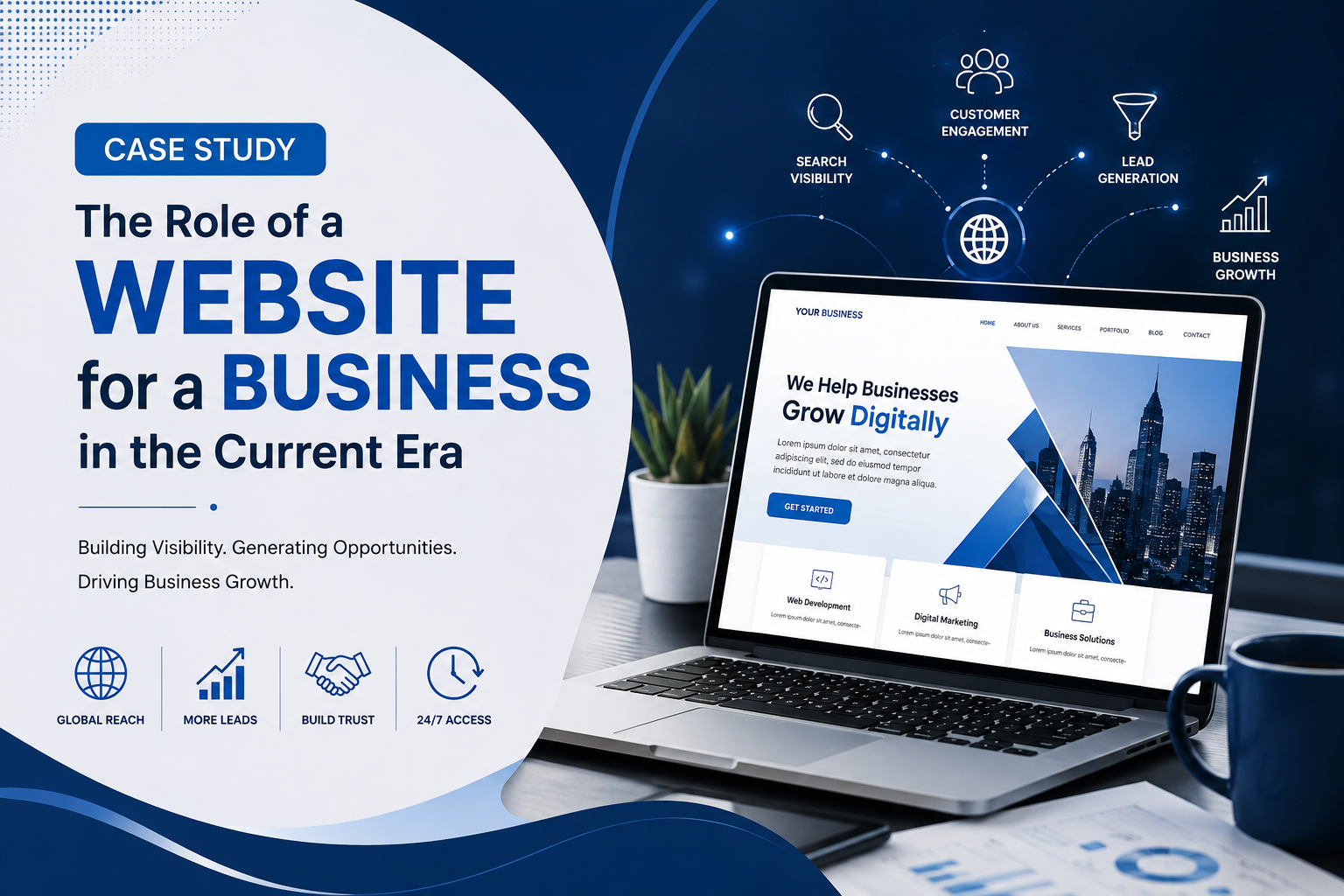
Case Study: The Role of a Website for a Business in the Current Era
Introduction
In the current digital era, a website has become one of the most important assets for any business. Customers increasingly use the internet to discover companies, compare products and services, read reviews, check prices, and make purchasing decisions. As a result, a professional website is no longer simply an online brochure; it has become a central part of a company's identity, marketing strategy, customer service, and business growth.
This case study examines the role of a website in modern business and explains how a well-designed website can help a company establish credibility, reach new customers, generate leads, increase sales, and compete effectively in a rapidly changing marketplace.
1. Background of the Business
Consider a hypothetical company named ABC Solutions, a small-to-medium-sized business providing IT services, website development, digital marketing, and business automation solutions.
Initially, ABC Solutions depended primarily on referrals, telephone calls, and local networking to acquire customers. Although the company provided quality services, its growth was limited because potential customers had difficulty finding reliable information about the company online.
The management decided to develop a professional, mobile-friendly website that clearly presented its services, previous projects, customer testimonials, contact information, and business expertise.
2. The Challenge
Before developing its website, ABC Solutions faced several challenges:
Limited visibility beyond its local market.
Heavy dependence on referrals and personal contacts.
Difficulty demonstrating its expertise to prospective customers.
Lack of a centralized source of information about its services.
Limited opportunities to generate leads outside business hours.
Difficulty competing with businesses that had a stronger online presence.
Customers had to contact the company directly for basic information.
These challenges demonstrated the need for a strong digital presence.
3. Implementation of the Website
ABC Solutions developed a professional website with several important features:
Company Information
The website included the company's history, mission, vision, expertise, and team information. This helped visitors understand who the company was and what it offered.
Services
Each service was presented on a dedicated page with clear descriptions, benefits, and examples. This allowed potential customers to understand the company's capabilities without immediately contacting the sales team.
Portfolio and Case Studies
Previous projects and successful client outcomes were displayed to demonstrate practical experience. This helped establish trust and credibility.
Customer Testimonials
Reviews and testimonials from existing customers provided social proof and helped reduce uncertainty for new visitors.
Contact and Lead Generation
The website included contact forms, enquiry options, email integration, and clear calls to action such as "Request a Quote" and "Schedule a Consultation."
Mobile Responsiveness
Since a significant portion of internet users access websites through smartphones, the website was designed to work effectively across desktops, tablets, and mobile devices.
Search Engine Optimization
The company optimized its website for relevant search terms so that potential customers could discover its services through search engines.
4. Role of the Website in Modern Business
4.1 Establishing Business Credibility
A professional website creates a strong first impression. Customers often judge the professionalism of a business based on its online presence.
A modern, secure, informative, and easy-to-use website can communicate that a company is legitimate, established, and capable of delivering quality services.
For ABC Solutions, the website became a digital representation of the company's professionalism.
4.2 Increasing Brand Awareness
A website allows a company to communicate its brand consistently through its logo, colors, messaging, content, images, and overall design.
Unlike traditional advertising, a website provides a permanent online location where customers can learn about the brand at any time.
4.3 Reaching a Wider Market
A physical office is generally limited by geography, whereas a website can be accessed by customers from different cities, states, and countries.
For ABC Solutions, this meant that the company could promote its services beyond its local market and attract clients from other regions.
4.4 Generating Leads
One of the most important roles of a business website is lead generation.
A website can attract visitors through search engines, social media, online advertising, and referrals. Visitors can then be converted into potential customers through enquiry forms, consultation requests, phone calls, or other calls to action.
This allows the website to function as a continuous lead-generation channel.
4.5 Supporting Sales
A website can provide customers with detailed information before they speak with a salesperson.
Service descriptions, pricing information, FAQs, portfolios, case studies, and testimonials can answer common questions and help customers make informed decisions.
Consequently, the sales team can focus more on qualified prospects rather than repeatedly explaining basic information.
4.6 Providing 24/7 Accessibility
Unlike a physical office, a website is generally available 24 hours a day.
Potential customers can visit the website during evenings, weekends, holidays, or outside normal business hours. This gives businesses an opportunity to receive enquiries even when employees are unavailable.
4.7 Improving Customer Experience
A well-designed website makes it easier for customers to find information.
Features such as:
Frequently Asked Questions
Online enquiry forms
Appointment scheduling
Product catalogs
Service information
Downloadable documents
Chat and support options
can significantly improve the customer experience.
4.8 Supporting Digital Marketing
A website acts as the central destination for many digital marketing activities.
For example:
Social Media → Website → Product/Service Information → Enquiry → Customer
Similarly:
Search Engine → Website → Content → Lead → Sale
Digital advertising, email marketing, social media campaigns, and content marketing can all direct users to the company's website.
4.9 Building Customer Trust
Modern customers often research a company before making a purchase. A website provides an opportunity to establish trust through:
Customer reviews
Certifications
Awards
Case studies
Company information
Professional photographs
Secure communication
Clear policies
Contact information
The more transparent and informative the website is, the easier it can be for customers to evaluate the business.
4.10 Competing in the Digital Marketplace
A company without a strong online presence may lose potential customers to competitors that are easier to find online.
A website allows small and medium-sized businesses to compete with larger organizations by showcasing their expertise, customer success stories, unique services, and value proposition.
5. Results of the Website
After implementing the website, ABC Solutions experienced several improvements:
Area | Before Website | After Website |
|---|---|---|
Online Visibility | Limited | Significantly improved |
Customer Information | Mainly through calls | Available online |
Lead Generation | Mostly referrals | Website + referrals + search |
Market Reach | Mainly local | Wider geographic reach |
Brand Image | Dependent on personal interaction | Professional digital presence |
Customer Support | Primarily during working hours | Information available 24/7 |
Sales Process | More manual | Better informed prospects |
The website therefore became more than an informational platform. It became an important business-development tool.
6. Key Lessons from the Case Study
The experience of ABC Solutions demonstrates several important lessons.
First, a website should be treated as a business asset rather than merely a technical project.
Second, website quality matters. A poorly designed, slow, outdated, or difficult-to-use website can negatively affect customer perception.
Third, a website must focus on the customer. Visitors should be able to quickly understand what the company offers, why they should choose it, and how they can contact the business.
Fourth, a website should continuously evolve. Businesses need to update their content, services, security, technology, and user experience according to changing customer expectations.
Finally, a website works best when integrated with other digital channels such as search engines, social media, email marketing, online advertising, analytics, and customer relationship management systems.
7. Challenges and Considerations
Although a website offers significant benefits, businesses must also consider several challenges.
Security
Websites must be protected against unauthorized access, malware, data breaches, and other security threats.
Maintenance
Content, software, plugins, integrations, and security systems require regular maintenance.
Performance
Slow-loading websites can create a poor user experience and may result in visitors leaving before contacting the business.
Mobile Experience
The website should function effectively on smartphones and tablets as well as desktop computers.
Content Quality
Outdated or inaccurate information can damage customer trust. Businesses should regularly review and update their website content.
Data Privacy
Businesses collecting customer information must handle personal data responsibly and comply with applicable privacy and data-protection requirements.
8. Future Role of Business Websites
The role of websites is expected to become even more important as businesses adopt technologies such as artificial intelligence, automation, personalization, conversational interfaces, online payments, and advanced analytics.
Future business websites may increasingly provide personalized content, AI-powered customer assistance, automated lead qualification, real-time recommendations, and integrated purchasing or booking experiences.
Therefore, the modern website is evolving from a static information page into an interactive digital business platform.
Conclusion
In the current era, a website plays a critical role in the success and growth of a business. It provides credibility, increases visibility, supports marketing and sales, generates leads, improves customer experience, and enables businesses to reach markets beyond their physical locations.
The case of ABC Solutions demonstrates that a well-planned website can transform the way a business communicates with customers and generates opportunities. However, simply having a website is not enough. Businesses need a website that is professional, secure, fast, mobile-friendly, informative, customer-focused, and regularly maintained.
Ultimately, a business website should be viewed not as an optional expense but as a strategic digital asset that can contribute directly to brand building, customer engagement, operational efficiency, and long-term business growth.